In November of 2022, OpenAI publicly released ChatGPT-3.5, a tool that could craft human-like responses to text-based inputs. The ability to nearly converse with a machine was widely considered to be a breakthrough in generative Artificial Intelligence (AI) and thus began the so-called AI revolution.
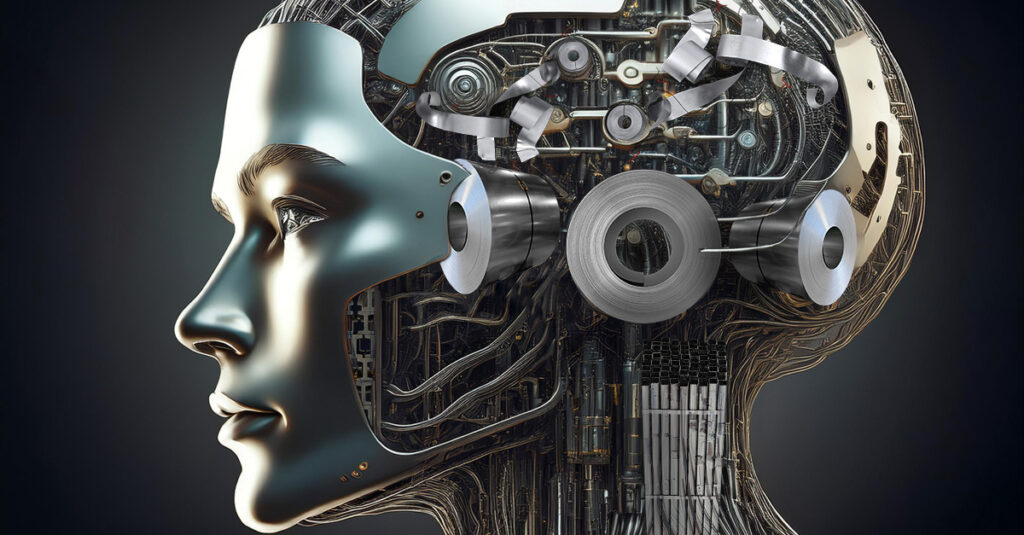
The general consensus is that AI will be a transformative technology for all industries, with metal service centers being no exception to this. However, despite the prognostications of various technology vendors, most of what is described as AI today is primarily regular software algorithms repackaged with marketing hype as artificial intelligence. In the few instances where true Large Language Models (LLMs) have been integrated into software applications, the results have been error-prone, unreliable, and more akin to a minor uprising as opposed to the promised revolution.
Goldman Sachs recently released a 31-page report titled “Gen AI: Too Much Spend, Too Little Benefit?“, casting doubt on the touted productivity benefits and potential financial returns while, like other publications, also noting the negative environmental impact from the enormous energy and freshwater demands to power the AI models.
Does this mean that the promise of AI will never materialize and the $1 trillion of investment about to be poured in will not result in any quantifiable productivity gains? Quite the contrary, the investments being made today will be foundational to growth and improved performance in LLMs but expectations must be recalibrated, and AI marketing must be viewed skeptically as we are currently in the infancy stage of the technology.

In computer science, there is a commonly used term called GIGO, shorthand for Garbage In, Garbage Out. This expression is used to describe the concept that poorly defined inputs will result in an output of equally poor quality. LLMs are trained on large data sets for deep learning, a Machine Learning (ML) technique that uses neural networks to recognize patterns and make associations. Much of the AI interaction today is the result of LLMs being fed inputs from disorganized, unsubstantiated sources such as social media pages and satirical websites, thus resulting in inaccurate and bizarre outputs.
Fortunately, in the world of ERP systems, a structured database provides the foundational element to create true value-added AI features. For example, the INVEX database operates as a rules-based engine that captures over 50,000 pre-defined data fields and intelligently organizes and stores them for analysis and retrieval. The result is a data set of excellent quality that can be fed into a potential ML model, thus circumventing the GIGO pitfall.
Building true productive AI functionality begins with focusing on applications that would benefit the most from assisted decision-making. Examples of two such areas are Inventory Planning and Sales Forecasting. In both these areas, the Invera data science team is using structured data from the INVEX database and machine learning to develop models for time series and regression analysis.
As an example, Invera is developing and testing models using ML to offer inventory management predictions and forecasting in the INVEX Material Resource Planning (MRP) application. On the sales side, ML models are being used to analyze INVEX Sales History data to offer sales forecasting and predictive analysis.
The productivity gains from AI will take several years to manifest itself, particularly when factoring in the resource-intensive nature and economics of deploying AI models. Today, any claims of true AI functionality should be met with a healthy dose of skepticism, however, the progress of the technology is remarkable and within a few years, the impact could be transformative. In order to truly benefit from this potential, having clean organized data sets to feed the AI models is critical. This will allow metal service centers to use AI technology to make better-informed decisions using data points not previously considered, and position themselves for the future, and avoid having to put out the (data) garbage for collection.
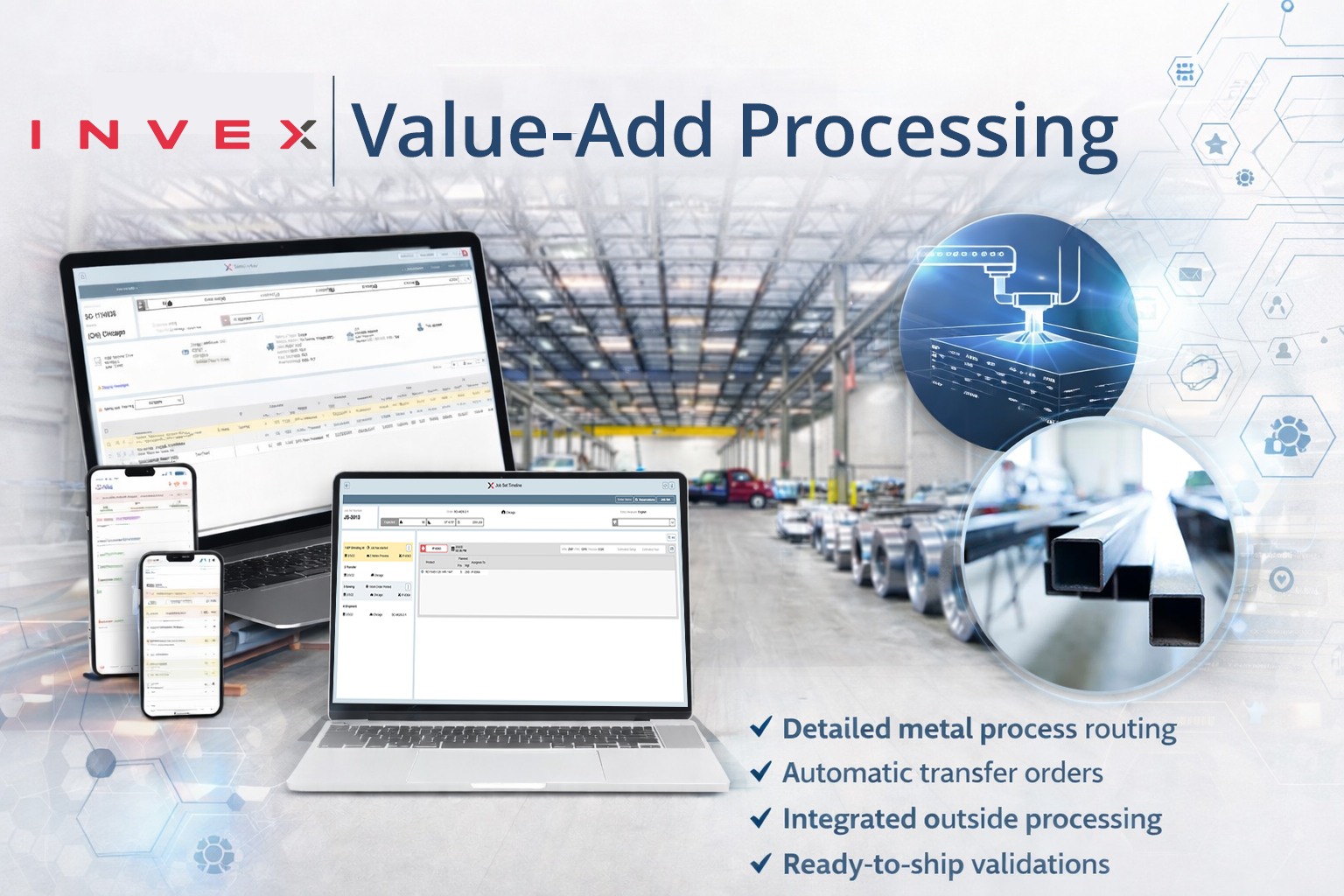
INVEX Metal Enterprise Software Spotlight: Features for Value-Add Processing
Dallas, TX – INVEX, the cloud-based enterprise software, purpose-built for metal service centers and processors, features advanced value-add processing capabilities. Designed specifically for the metal industry, INVEX delivers comprehensive warehouse production and routing functionality that supports single and multi-step processing across multiple facilities and outside processors—while providing precise line-item profitability analysis. INVEX is a leading cloud…

XCELERATE 2026: The Launch of INVEX AI
Xcelerate 2026, taking place May 12–14, 2026, will bring together metal service center leaders and technology innovators for three powerful days dedicated to accelerating performance with INVEX. Designed to inspire learning and spark meaningful connections, the conference will feature dynamic sessions led by the Invera team, packed with insights and strategies to help your metal…
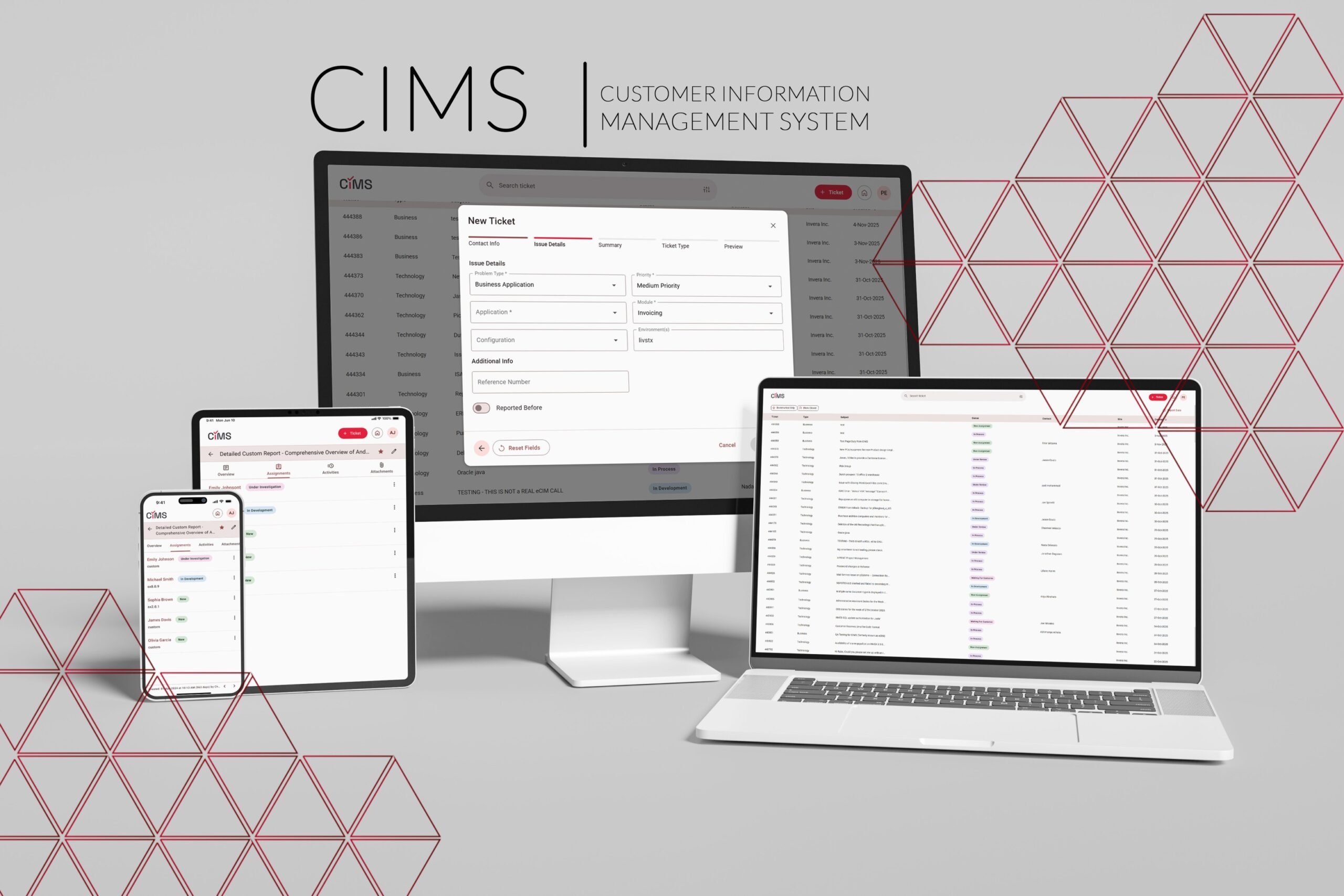
Introducing CIMS: The New Invera Customer Information Management System
Dallas, TX – Invera is pleased to announce the release of the new CIMS (Customer Information Management System), the next generation of our support ticket platform replacing eCIM. The new CIMS features a modern, mobile-friendly design that enhances communication, visibility, and security for both customers and business partners. Starting Friday, November 7, at 6 PM…